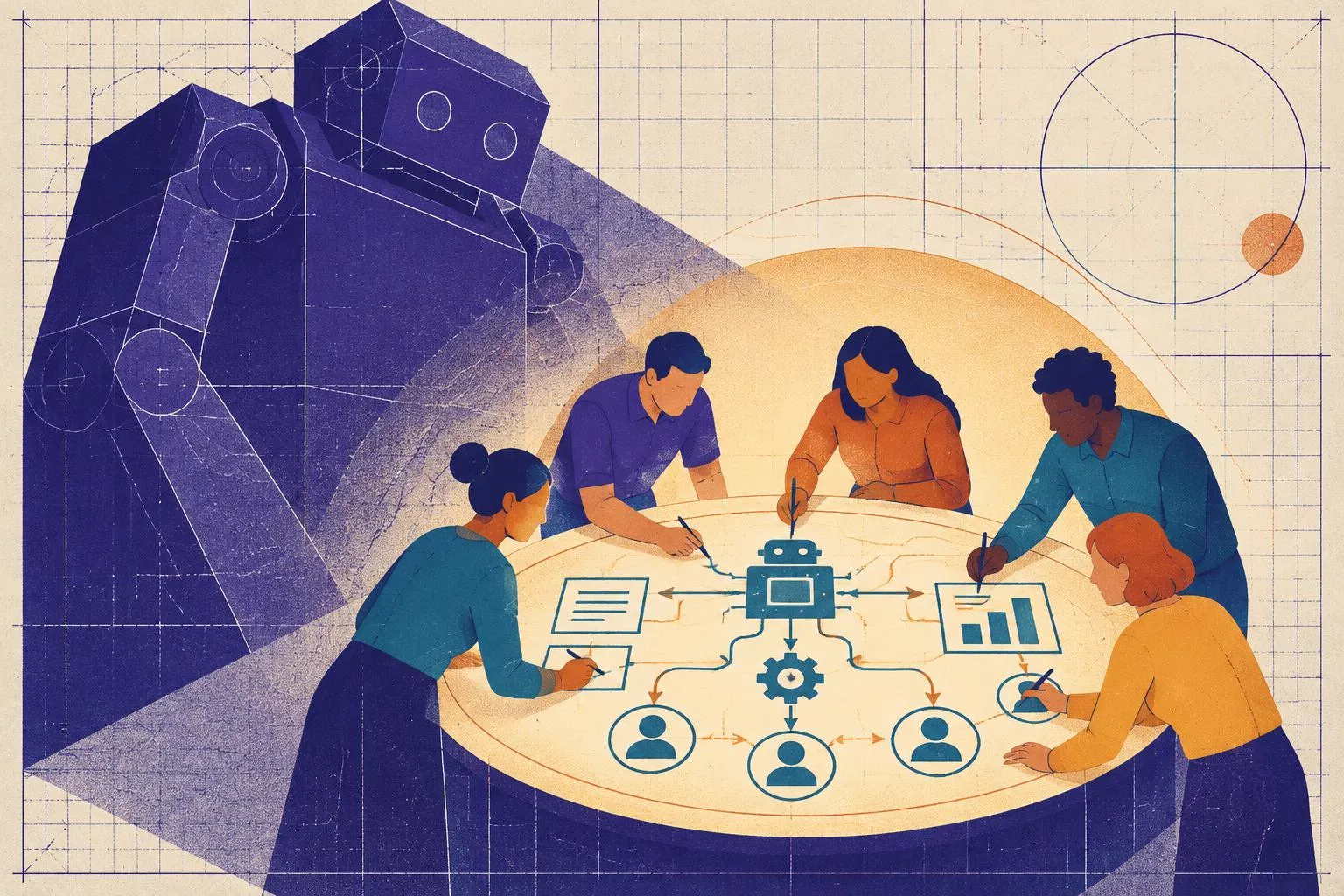
A friend took a role leading AI transformation inside a firm. Before she’d learned how anything worked, the employees had already decided what she was there for. Leadership hired her to replace them.
They stopped sharing information. Kept her away from their processes. The people she needed most shut the door.
I get it.
"AI transformation" sounds different depending on which side of the table you’re on. Leadership hears efficiency, innovation, an edge. Employees hear: tell us everything you know so we can figure out how to need fewer of you.
That is not a literacy problem. It’s a trust problem. And no slide about how exciting AI is will touch it.
First, get the assignment straight. You weren’t hired to do AI. You were hired to change how work gets done, and the people doing it have already decided that means fewer of them. Until you deal with that, everything else you build is furniture.
Don’t promise what you can’t control
I won’t start by telling people AI will never touch their jobs. I don’t control the company’s headcount decisions, so I can’t make that promise and mean it.
The moment you promise, you’ve borrowed a problem that belongs to leadership, and employees will test you on it the first week.
What I can say is my own line. If a company’s goal is to replace people with AI, I’m not the right partner.
That’s partly values. People need work. Jobs hold up lives and families and health and some basic sense of stability, and the world isn’t handing out much of that these days.
It’s also an operating judgment. Most jobs are not one task. They’re a knot of decisions and relationships and exceptions and institutional memory and coordination and judgment. AI can do or help with pieces. It can’t reliably take the whole role, especially where the work touches money, law, customers, or safety. And when it drops one of those, you’ll be the one blamed for it.
The research is calmer than the headlines. A 2025 International Labour Organization study found one in four jobs has some exposure to generative AI, and concluded transformation is far more likely than elimination. Only about 3% of global employment lands in its highest risk category. Stanford’s 2025 AI Index found productivity gains that are real but uneven, and wholesale displacement that still hasn’t shown up in the data.
None of that means no one will lose a job to AI. Some companies will use it that way, sometimes well, sometimes with consequences they didn’t see coming. Employees know this. Pretending otherwise just deepens the trust problem.
So before asking anyone to participate, leadership has to answer one question straight: is reducing headcount part of what we’re doing here?
If the answer is no, say it, write it down, and make sure the measures back it up. If it’s yes, people deserve the truth. If leadership won’t answer, the person running the transformation should not be expected to manufacture reassurance for them.
Leadership also has to make participation possible at all. You can’t hire someone to redesign work, deny them trusted access to the people doing it, then blame them when nothing changes.
People need time to take part. Permission to question the premise, flag risks, say this proposed use of AI doesn’t make sense. And they need to know that explaining their work won’t be used against them. The AI lead can’t build those conditions alone. Leadership has to make participation safe and answer the employment questions that sit outside her authority.
Start with the work that’s harder than it needs to be
Most places don’t have a shortage of work. They have a surplus.
Hours go to hunting for information, copying data between systems, updating records, rebuilding context, chasing approvals, fixing small inconsistencies, documenting decisions after the actual work is done.
Each task looks tiny. Two minutes here, three there. Added up, they eat a shocking amount of time and attention.
So this is where I’d begin with a team that doesn’t trust me yet.
- What do you keep putting off because it’s tedious?
- What takes far longer than it should?
- Where are you typing the same thing twice?
- What work quietly gets dropped when it’s busy?
- Which exceptions need someone who’s been around long enough to know what the official process leaves out?
Their answers tell me more than any list of proposed AI use cases. They show where skilled people are being used as glue between systems, where the process runs on memory, where work has piled up around a problem no one’s had time to redesign.
People will answer. Not because they trust you yet, but because they’ve been dying for someone to ask.
The goal isn’t to automate everything people dislike. Some frustrating work is there to protect customers, catch mistakes, hold someone accountable. The goal is to understand why the work exists, what judgment it contains, and whether a better process can lift the burden without lifting the protection.
Sometimes the answer is AI. Sometimes it’s a query, a rule, an integration, clearer ownership, better documentation, or deciding a task can simply stop. This is a case for better automation, not AI, because what you need is exact, not interpreted.
Employees should help decide where AI belongs
The people doing the work aren’t an adoption obstacle. They’re usually the ones who can tell you exactly where the shiny new system will fail.
They know which source is usually out of date. Which customer doesn’t fit the standard category. Which approval exists for a reason and which survives only because nobody’s touched it since three reorganizations ago. Where the official workflow and the real workflow parted ways.
Which is why direct access to employees is not negotiable. You cannot redesign work from an executive briefing. Without the people who know the real process, the exceptions, and the cost of getting it wrong, the whole thing is performance.
I’ve written before that we should let employees break the AI. That’s not just a testing technique. It’s how trust gets built.
Hand them the proposed workflow. Give them real cases, including the ugly ones. Show them what the system used, what it produced, what it changed, where it was unsure. Let their corrections change the design.
Their involvement should also set how much control the system gets. I don’t start from the assumption that every process aims at full autonomy. I want to know where human judgment changes the outcome, what’s safe to automate, what happens when the normal path fails, and how much control the person accountable for the work is willing to hand over.
That answer differs across a workflow. Some decisions stay fully human. Elsewhere, AI might prepare work for review, act inside clear bounds while someone watches, or handle one narrow task on its own. The split should come from understanding the work and its consequences, not from deciding in advance that more automation is always better.
Comfort isn’t the only design criterion, but it’s useful signal. If someone won’t trust a system to act without review, I want to know why. They may be protecting judgment the workflow never made visible.
But participation has to be real. If leadership already picked the tool, set the outcome, and decided which work disappears, a listening session is just a meeting where people describe a decision they weren’t allowed to touch.
Measure whether the work actually got better
I would not grade success by how many people opened the tool or how many prompts they typed.
Usage tells you something got used. It says nothing about whether the work got faster, more accurate, less frustrating, or safer. And it says nothing about trust. A company can post great adoption numbers while employees quietly route around the thing, double check everything it emits, or absorb a new review burden nobody counted in the savings.
If the stated goal is to make people’s working lives better, the measures need to reflect that.
I’d want to know: Did searching, copying, reconciling, and updating actually take less time? Did rework and errors fall? Did people get context earlier? Was the work easier to hand off? Did anyone get time back for the decisions and relationships that need their expertise? Or did the system just create a new review queue that ate the savings? And did the pace become manageable, or did leadership simply raise the target?
A meta-analysis from the University of Oxford, covering 339 studies and 1.8 million employees, found employee satisfaction moves with productivity, customer loyalty, and profitability, and against turnover. That’s correlation, not causation, and I won’t dress it up as anything else. But it matches what a lot of operators already know: employee experience is part of the operating system, not a perk bolted on next to it.
If a company measures only usage, hours removed, or tasks automated, people will reasonably conclude headcount reduction is the real objective. If it measures quality, capacity, correction burden, effort, and customer outcomes, it’s at least measuring the change it claims to want.
Learning should build agency, not another threat
I believe people who learn to use AI well become more valuable where they are and more capable wherever they go next.
That does not mean everyone should become a prompt engineer. I’ve argued before that employees shouldn’t have to get good at AI before the tool can help them. They shouldn’t have to wrestle a blank chat box, rebuild all the context, verify unsupported output, and drag the answer back into the real workflow by hand.
Learning should be tied to the work. People need to understand what the system can do, where it fails, what it uses, what stays theirs to decide, and how to challenge or correct it. They also need protected time to practice. Training stacked on top of an already full week isn’t much of an investment.
The aim isn’t to convert everyone into AI enthusiasts.
It’s to give people enough information, authority, and evidence to decide whether a change deserves their trust. To remove the work that wastes their time while protecting the judgment and relationships that make their work worth something.
If employees believe an AI initiative is being done to them, no amount of reassurance fixes it.
The work has to be designed with them, and it has to make their lives measurably better. Reassurance won’t open a shut door. Only that will.